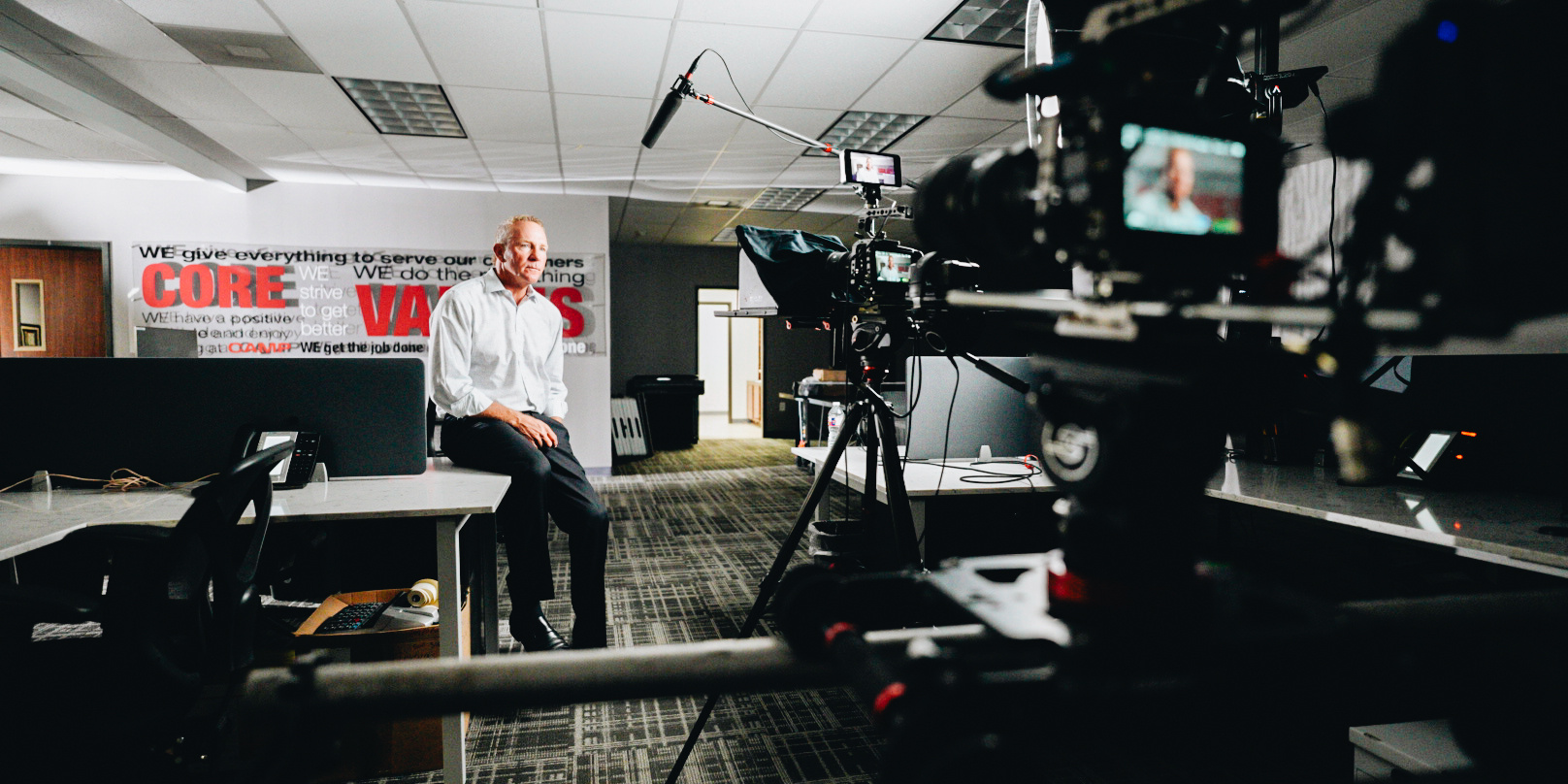
B2B companies love to finish content.
Finish the brand video.
Finish the newsletter.
Finish the webinar.
Finish the blog article.
Then everyone moves on, relieved that the thing is finally done.
The "done" mentality is one of the biggest reasons B2B video fails. Companies treat video like a project to complete instead of a system to build. They produce one asset, launch it, post it once on social, embed it on the site, and then wonder why it didn't move the business.
One video was never going to move the business.
A single video can make an impact, but you need more to make a shift.
Learn more by watching "Breaking The Chains of B2B Video Content" on the Content Wars Podcast.
You don't need more video. You need a structure.
Most companies misdiagnose this. They say, "We need more video."
Maybe. But more random video just creates a bigger mess.
The real problem is that most B2B companies have no repeatable content structure. They start from scratch every time. New idea, new plan, new approvals, new production, new distribution scramble.
That is why video content feels expensive, slow, and why it is so inconsistent.
It is not that video is inaccessible. It is that the company treats every video like a custom home build when it should be running a scalable system.
You need shows, not videos.
The word "show" makes some B2B leaders nervous. They picture bright lights, forced charisma, and someone yelling, "smash that subscribe button." Calm down. Nobody needs your VP of Operations to turn into a YouTube personality.
A show is just a repeatable format with a clear premise.
That could be:
- A monthly industry breakdown
- A recurring customer proof series
- A product education series
- An executive POV series
- A weekly expert conversation
- A video podcast
The goal is to be consistent.
Consistency gives your audience a reason to come back. It gives your team a structure to plan around. It gives production a format to repeat and distribution something to build on. Most importantly, it gives the market repeated exposure to your ideas and messages.
Repeated exposure is how trust gets built.
"We made the video, so we're done."
That mentality makes sense if video is a deliverable. It falls apart the moment you treat video as a communication system.
Your audience does not understand your company after one message. They don't trust your point of view after one post. They don't remember your differentiation after one brand video. They don't suddenly prefer you because you released a nice testimonial.
That is not how belief works.
Belief is built through repetition, depth, proof, and timing.
Your buyers are not all in the same place at the same time. Some don't know they have the problem. Some know the problem but not the cost. Some are comparing options. Some are defending the status quo. Some are almost ready and just need confidence.
A handful of isolated videos can't speak to all of that. A consistent system can.
Episodic content makes distribution easy.
This is the part most companies miss.
One long-form episode can become a full YouTube video, a stack of Shorts, LinkedIn clips, sales follow-up assets, newsletter content, blog topics, and paid social creative.
A lot of leaders assume long-form video only pays off if people watch the whole thing. Wrong. Long-form is valuable because it creates depth and a source asset you can cut into sharper pieces for different platforms and audiences.
A 30-minute conversation with the right expert can fuel weeks of content.
A webinar becomes a replay, a set of clips, an article, and a sales enablement resource.
A customer interview becomes a proof video, social clips, quote graphics, and objection-handling content.
That is what thinking in systems looks like.
YouTube rewards continuity.
YouTube is not built for isolated corporate uploads. It is built to keep people watching — playlists, Shorts, subscriptions, recommendations, related videos.
Upload once every six months, and good luck ever getting traction.
The platform needs recurring content that fits together. The audience needs context. The channel needs a point of view. A channel built on recurring topics and playlists has a real shot at becoming useful. A channel full of disconnected campaign videos doesn't.
This is why podcast-style content works for so many B2B companies. Not because everyone needs a podcast, but because podcasts force episodic discipline. They create a standing reason to record, publish, clip, and distribute.
The same principle applies to demos, customer stories, market commentary, training, or expert Q&A. The format matters less than the continuity.
Ask a better question.
Stop asking, "What video do we need?" That question produces one-off thinking.
Ask, "What conversation do we need to own in our market?" That question produces a strategy.
If you want to be known for solving a specific problem, your content should hit that problem from every angle.
If buyers misunderstand your category, build a series that reframes it.
If your sales team keeps hearing the same objections, answer them with video before the call.
If your product needs education, build a learning series.
If your customers are your strongest proof, make customer stories a rhythm, not an occasional scramble.
This isn't content for content's sake. It's building a body of work that compounds.
Stop making videos that die alone.
A one-off video has to carry too much weight. It has to get attention, explain the idea, create interest, support sales, and justify its cost. That's too much to ask of one asset.
A system spreads that weight out. Each video does a job. Each clip extends the message. Each episode builds familiarity. Each repeated idea strengthens your position.
The companies that win with video won't be the ones making the prettiest one-off pieces. They'll be the ones that show up consistently, with a clear point of view and a system for turning every conversation into ongoing market communication.