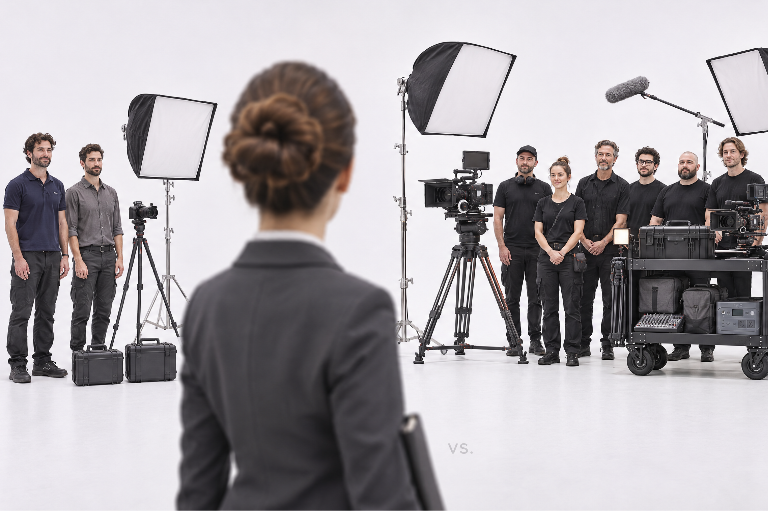
Why “We Don’t Have a Budget” Makes Your Video Worse
Most marketing teams treat their video budget like a poker hand, refusing to reveal it until vendors bid. That instinct backfires, because vendors who don’t know your number assume they must be the cheapest option and quietly cut crew, equipment, and editing to get there. Sharing a realistic range turns three incomparable guesses into options you can actually weigh. After reading, you’ll know how to talk about budget in a way that protects both your money and the quality of what you’re buying.

Ask any production company for a quote and one of the first questions you’ll hear is, “What’s your video production budget?” Most B2B marketing teams answer the same way. “We don’t have one.” Or, “We don’t know yet.”
It feels like smart negotiating. Keep the number close, make vendors show their cards first, and avoid getting talked into spending more than you need to.
In practice, it’s the most expensive answer you can give. You may not pay more. You’ll almost certainly get less video for whatever you do spend.
Learn more by watching “This Is Killing Your Video Projects” on the Content Wars Podcast.
What vendors hear when you won’t share a video production budget
When a production company asks about budget, they aren’t hunting for the maximum they can charge. They’re trying to figure out what level of production you expect.
The range is wider than most marketers assume. For example, a legit commercial may be a $15,000 project or a $500,000 project. The difference shows up in whether there’s a real director, true cinema cameras and lens kits, or something a few levels down, a crew of fifteen or a crew of three. Is there talent? What are the locations and do they have to be built? What about special effects, cinematic color grading, or custom music? The choices are endless and the budget determines what's possible.
Even a simple request to film a one-day shoot for brand film could honestly be quoted anywhere from $2,000 to $200,000, depending on what’s expected at the end.
So when you say “we don’t know,” the vendor has to guess. In that situation, almost every vendor makes the same assumption: you’re shopping on price, so they need to be the cheapest bid.
From there, decisions start happening, and you never see the options. Fewer crew members. A smaller light kit. Lenses a couple of levels down. Less time in the edit. None of it appears on the quote as a line item called “corners we cut.” It shows up later, in the finished video.
You're literally asking for a race to the bottom.
“I don’t know” and “I don’t have one” are different answers
These phrases get used interchangeably. They shouldn’t be.
“I don’t know our budget” is an honest, solvable problem. A good video production partner can walk through what the project needs and help you land on a reasonable number.
“We don’t have a budget” is almost never true. Here’s the test: if a vendor came back at $100,000 and your first reaction was “whoa, that’s way too much,” you have a budget. You know what you don’t want to spend. That reaction is information, and holding it back makes every quote you receive less accurate.
Should you tell a video production company your budget?
Yes. Sharing a budget range gives vendors a fixed target, so their scopes and quotes reflect the same level of production and you can compare them honestly. It also removes the incentive to quietly cut quality just to guess their way into being the lowest bid.
The usual objection is that every vendor will come back just under your ceiling. Some will. But look at what you get when you withhold the number: three quotes built on three different guesses, with no fair way to compare them. The secrecy didn’t protect your money. It made the quotes questionable and the result you'll recieve diminished.
A range takes most of the risk out. Telling vendors you have between $10,000 and $20,000 doesn’t commit you to the top of it. It invites each one to show you what $10,000 buys, what changes at $15,000, and what $20,000 adds. When several companies answer the same range, you finally have quotes in the same neighborhood.
How to share the number and still get a fair deal
Lead with the business purpose. What is the video supposed to do, who is it for, and how will it be used once it’s delivered? Then give the range and ask for options inside it.
What comes back will tell you a lot about the vendor. Sometimes the ideal version of the project sits outside what you have, and a trustworthy partner will say so plainly. Other times a few adjustments, like a leaner crew or fewer edited versions, pull it back into range without hurting what matters.
Either way, you’re choosing the trade-offs on purpose. The alternative is letting a vendor choose them for you in private, with the single goal of winning the bid.
Your budget is a creative decision
Marketing leaders tend to treat the budget as a negotiating chip. In video, it works more like a creative brief. It decides who shows up, what they bring, and how much care goes into the finished product.
Refuse to set it, and someone else decides what your video is worth. They’ll do it by cutting until the number is low enough to win.